
Imagine this, It’s the late 1900s, and John, a young farmer, has just received a letter from his brother, Samuel, who’s moved to another country in search of better opportunities. Samuel wants to send some money home to help the family, but how can he do it? There’s no internet, no mobile phones, and no apps. What was once a simple letter in the post is about to transform into a journey across oceans, through the hands of strangers, couriers, and eventually into John’s hands, if it even makes it. It’s a world of uncertainty, where the process of sending money home is a complex dance of trust and hope. In this blog we will discuss the different ways of sending money across borders, this will include the processes used by banks and also touch on the money transfer companies that are involved in the process such as Western Union and MoneyGram
Early Methods of Sending Money
In the days before formal banking channels, people had few options for sending money to loved ones far away. If Samuel wanted to send money to John, he’d probably hand the cash to a friend, a traveler, or a trusted intermediary, hoping it would reach its destination safely. But this method was fraught with risks of money could be lost, stolen, or delayed for weeks, sometimes even months. Imagine the anxiety of waiting, not knowing if the money would ever arrive.
Trust was everything in this system. Without contracts or insurance, people had to rely on the integrity of those delivering the money. It wasn’t perfect, but it worked—at least, most of the time
The Rise of Formal Banking Channels
As global trade expanded in the 19th and early 20th centuries, financial service providers that specialize in remittances such as Western Union began offering formal remittance services. The process, while more reliable than informal channels, was often cumbersome. Typically, individuals would visit their local bank to initiate a transfer, providing the recipient’s banking details, the amount to be sent, and any necessary identification documents.
For decades, traditional remittances followed a straightforward process as illustrated below:
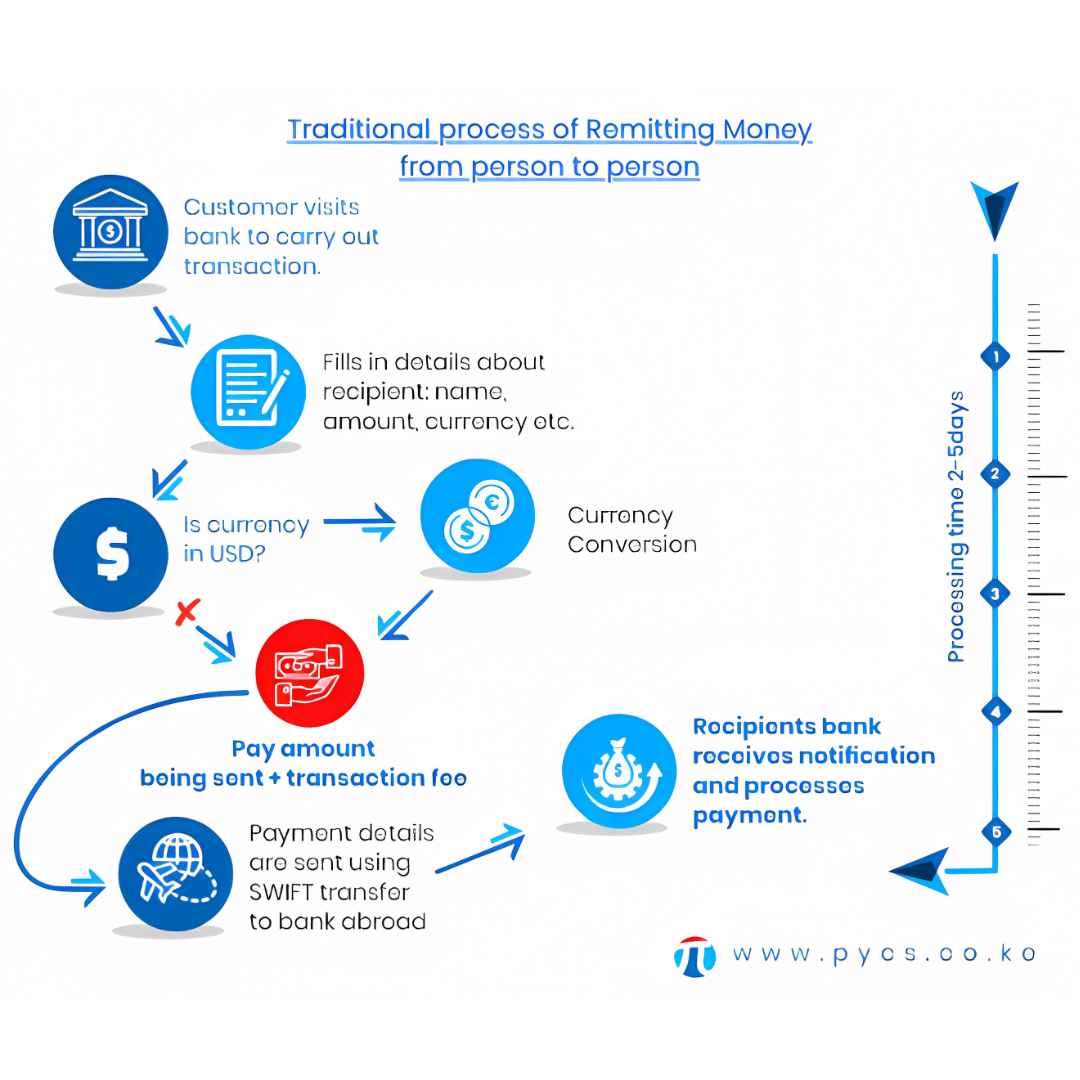
- Sender Initiates Transfer: The sender provides the recipient’s bank details such as Bank Identifier Code (BIC) and SWIFT code
- Instruction Transmission via SWIFT: The sender’s bank uses the Society for Worldwide Interbank Financial Telecommunication (SWIFT) network to send payment instructions to the recipient’s bank.
- Intermediary Banks Involvement: If no direct relationship exists, intermediary banks route the funds via SWIFT.
- Role of ACH: In the recipient’s country, Automated Clearing Houses ACH processes and clears the transaction between banks. Automated Clearing Houses batches and clears payments between banks, acts as an intermediary.
- Recipient’s Bank Credits Account: The recipient’s bank credits the funds to their account, completing the transaction
The process, however, wasn’t easy. Samuel would have to visit a local bank, fill out forms, and provide all sorts of details, from bank codes to identification documents. Once the money was sent, it traveled through a network of intermediary banks, each adding its own fees and delays to the process. Finally, John’s local bank would receive the funds, clear them through their Automated Clearing House (ACH), which is an electronic system that batches and clears payments between banks, ensuring that funds are accurately debited and credited to the appropriate accounts.
Challenges with Traditional Remittances
For decades, the global remittance system presented several key challenges, including:

- Long Processing Times: Transfers often took days, with delays from intermediary banks and compliance checks.
- High Costs: Fees were charged at multiple stages—by the sender’s bank, intermediary banks, and the recipient’s bank.
- Lack of Transparency: Senders were often unaware of the full costs involved, especially with hidden fees charged by intermediary banks and unfavorable exchange rate margins.
- Limited Accessibility: Access to formal banking systems was a barrier, particularly for people in remote or underbanked areas.
- Security Concerns: Security was a key challenge in traditional remittance due to multiple intermediaries and slow processes, increasing the risk of fraud and errors.
The Emergence of Modern Remittance Solutions
As time went on, the world became more connected. More people moved abroad, and the demand for faster, easier remittance services grew. That’s when companies like Western Union and MoneyGram stepped in to change the game.
Suddenly, sending money didn’t require a visit to the bank. Samuel could simply visit a Western Union agent to send money to John. The funds could be made available almost instantly, and all John needed was a transaction reference and his ID to collect the cash. It was a massive leap forward—a way to send money quickly and securely, bypassing the long waits and high fees of traditional banks This was facilitated through an MTO(Money Transfer Operator) which is a company that offers money transfer services to individuals and businesses. The process of transferring money using MNO is as follows:
- Initiation at Agent or Online: The sender visits an agent or uses the MTO’s platform, providing recipient details and paying the transfer amount and fees.
- Processing of Transfer: The agent inputs the details into the MTO’s system, which sends them to the central processing system.
- Fund Availability: The MTO authorizes the payout, making funds available at the recipient’s local agent, often instantly.
But even this system wasn’t without its challenges. High fees, limited transparency, and access issues still plagued remittances. Many people were unaware of the hidden costs involved, such as unfavorable exchange rates or additional charges imposed by intermediary banks.
The Digital Revolution: A New Era for Remittances
As we moved into the 21st century, technology began to reshape the way we send money across borders. Fintech innovations brought about a sea change in the remittance landscape. Companies like PYCS, in partnership with other remittance providers, began innovating platforms that made it possible to send money quickly, affordably, and securely—all with the tap of a button.
One such innovation was the introduction of Automated Payment Gateways, which are defined as a secure, intermediary technology that facilitates the transfer of payments between a customer’s payment method (such as credit/debit cards, digital wallets, or bank accounts) and the recipient’s bank or mobile wallet, was a game changer. With these gateways, payments can be seamlessly sent to bank accounts, as well as mobile wallets for both customers and businesses. One such payment gateway leading this revolution is Zamupay, a comprehensive payment automation and processing platform designed to meet the diverse financial needs of businesses such as bulk payments and remittances. By integrating cutting-edge technology with multiple payment options, Zamupay is reshaping how money is transferred across borders and within local markets.
Imagine Samuel now, sitting at his computer, sending money to John with just a few clicks. The funds transfer seamlessly from his digital wallet to John’s mobile wallet or bank account, with no delays, no hidden fees, and complete transparency.
At PYCS, our solutions, including Zamupay, are designed to offer businesses robust and reliable financial services, ensuring seamless operations and peace of mind. The key benefits of our solutions include:
- Seamless API Integration: Our flexible APIs allow for easy integration into your existing systems, streamlining processes without major technical overhauls.
- 99% Uptime: Enjoy consistent, reliable service with near-perfect uptime, minimizing disruptions and ensuring smooth operations at all times.
- Scalable: Whether you’re a small business or rapidly growing, our solutions scale effortlessly to accommodate increasing transaction volumes.
- 24/7 Support: We provide around-the-clock support, ensuring that any challenges are resolved promptly, so your business never skips a beat.
- Security: With advanced security measures in place, we prioritize the protection of your data and transactions, giving you confidence with all our solutions.
As the remittance landscape continues to evolve, automated payment gateways like Zamupay are at the forefront of this transformation. By offering real-time processing, cost-effective solutions, and multi-channel support, Zamupay helps businesses operate more efficiently and connect with customers globally. Whether it’s facilitating bulk payments, improving cash flow, or enhancing security, Zamupay represents the future of payments—one that is fast, secure, and designed for the digital age.